Neon eye tracking glasses by Pupil Labs
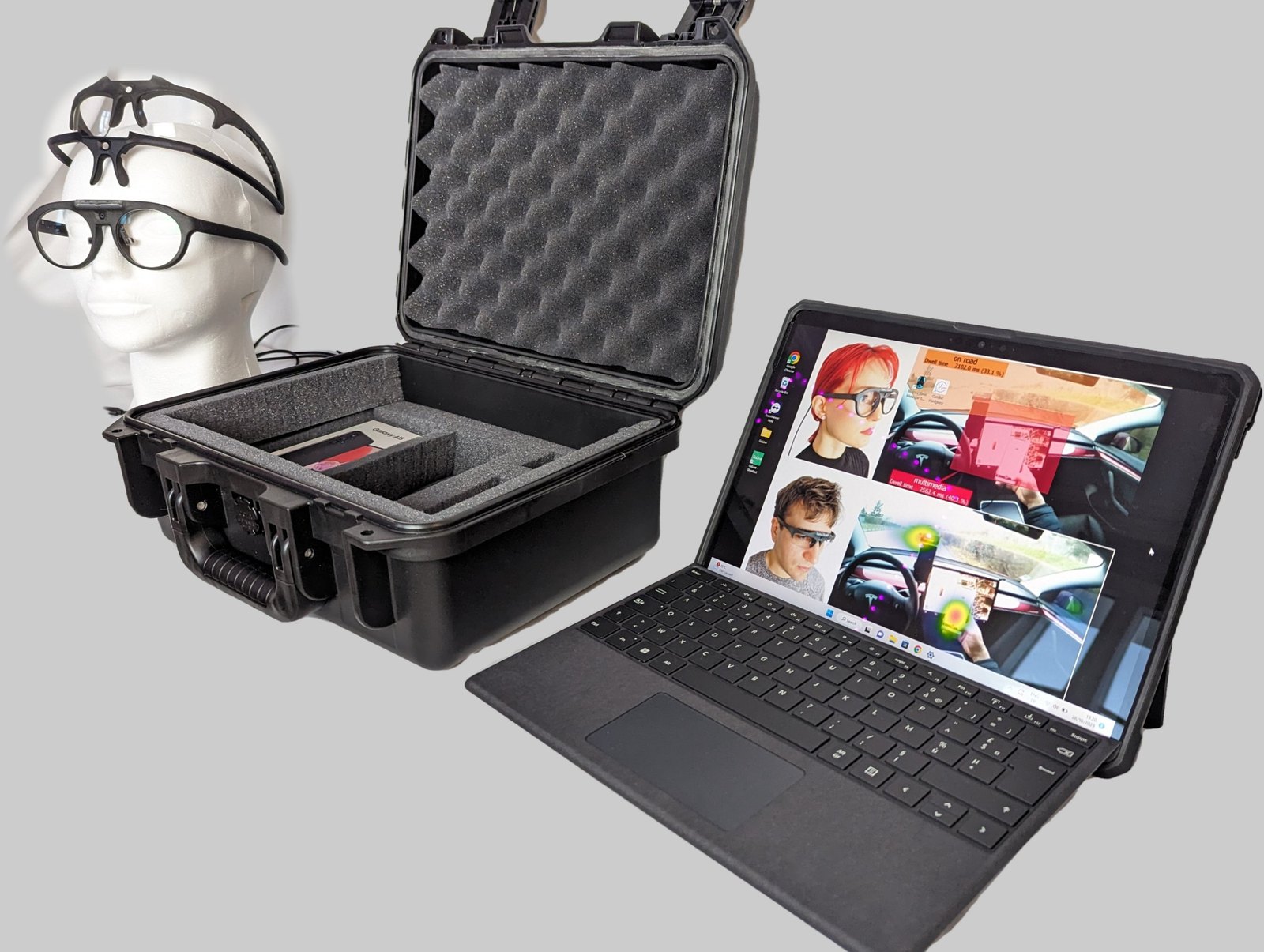
Neon is a 7-gram module that clips into a glasses frame. The participant puts the glasses on and recording starts: no adjustment, no calibration. Gaze Intelligence distributes Neon Pupil Labs and adds what we have been doing for more than 15 years: analysis in SMI BeGaze and live observation with GoLive.
At a glance
| Neon Pupil Labs | |
|---|---|
| Calibration | None |
| Gaze sampling rate | 200 Hz, binocular |
| Accuracy | 1.8° uncalibrated; 1.3° with offset correction |
| Scene camera | 1,600 × 1,200 pixels at 30 Hz, 103° by 77° field of view |
| Module | 7 g, fits 14 frames, two of them for children aged 2 to 8 |
| Battery life | 4 hours of recording at 200 Hz |
| Measurements | Gaze, fixations, blinks, pupil diameter, head movements, audio |
| Analysis | Pupil Cloud, Neon Player, SMI BeGaze, Blickshift Analytics |
| Live observation | GoLive, on a tablet, with ECG |
One module, several frames
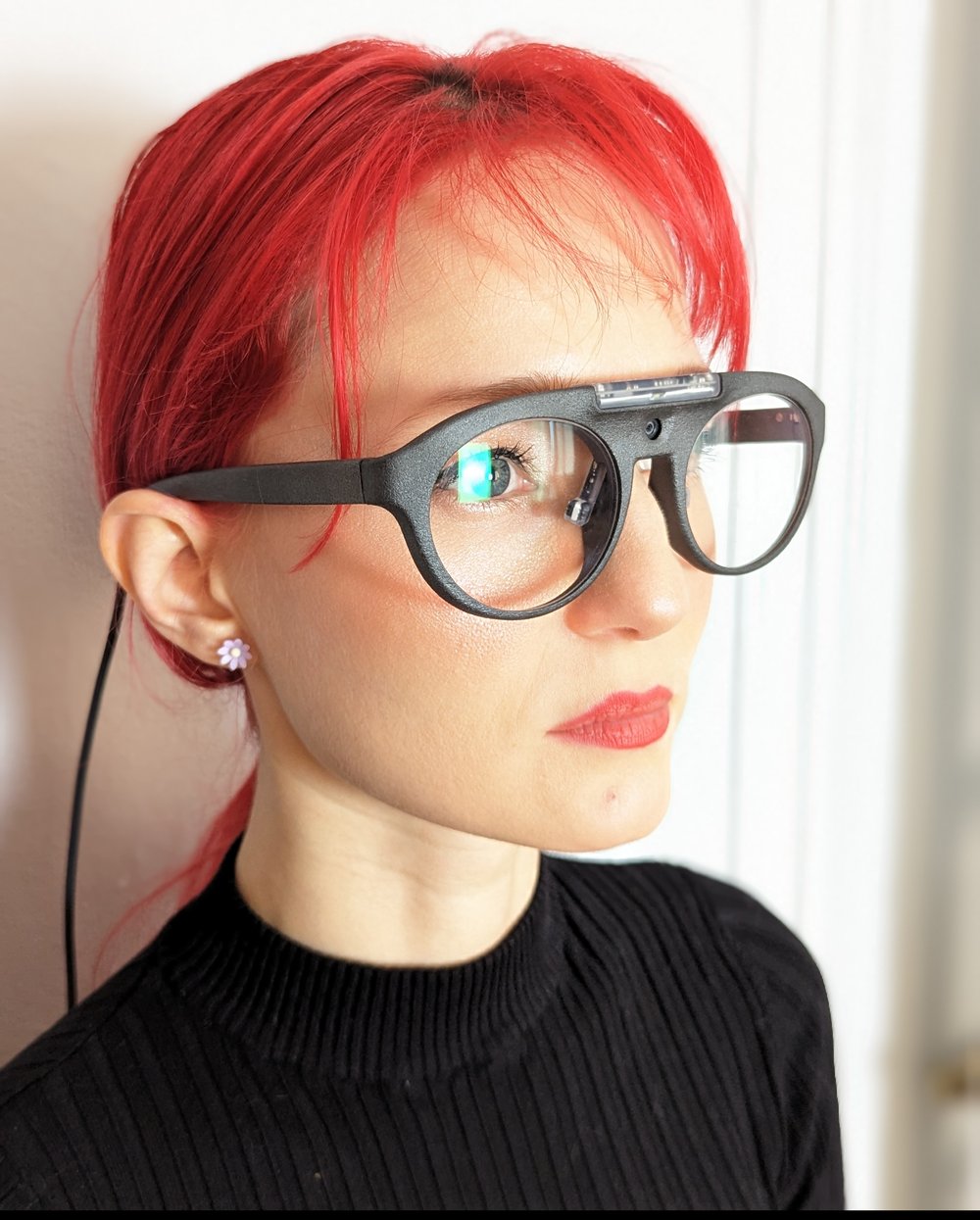
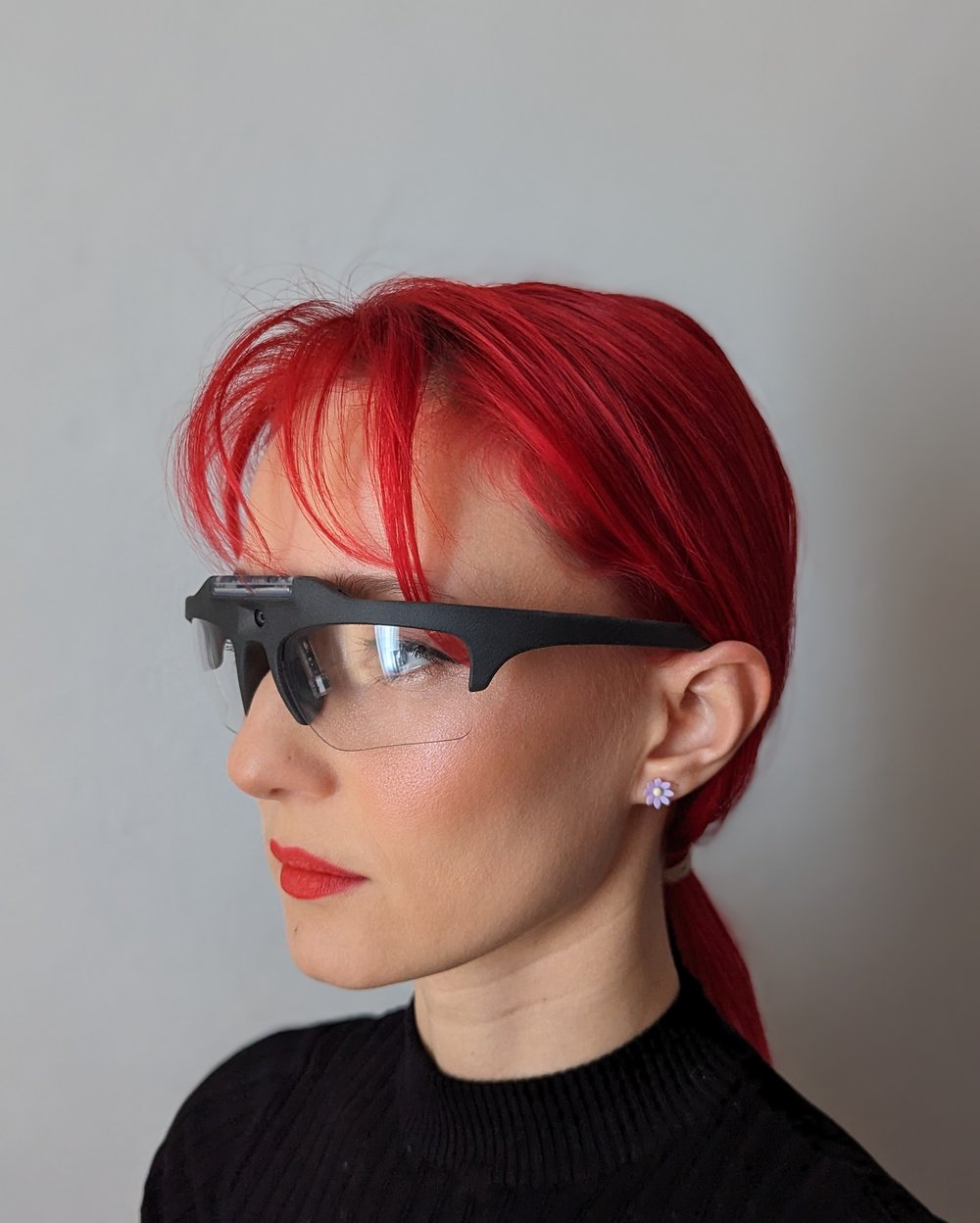
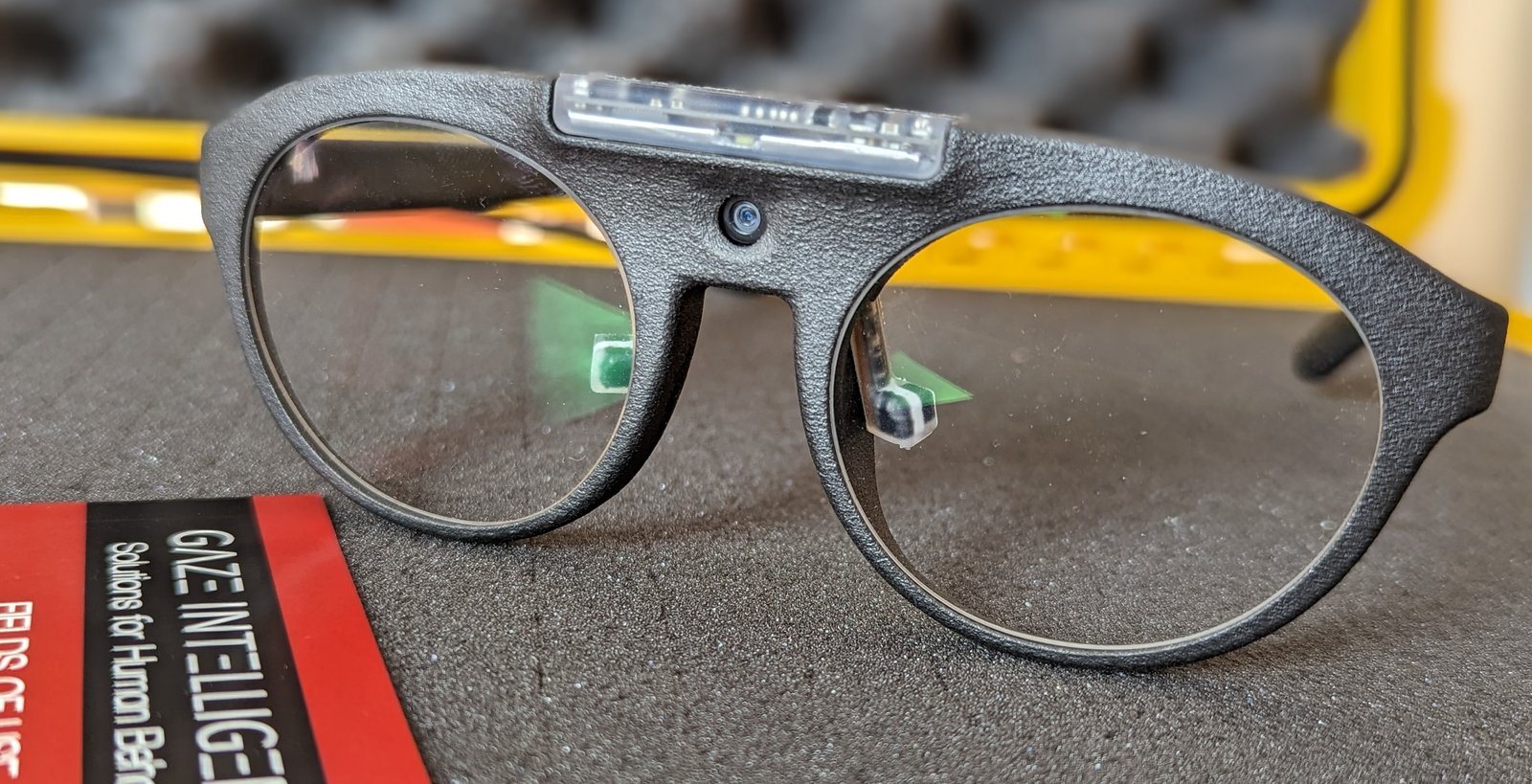
Neon packs two infrared eye cameras, a wide-angle scene camera, two microphones and an inertial unit into one small module. The module attaches to the frame that suits your study and connects through a USB-C cable to a phone, which records.
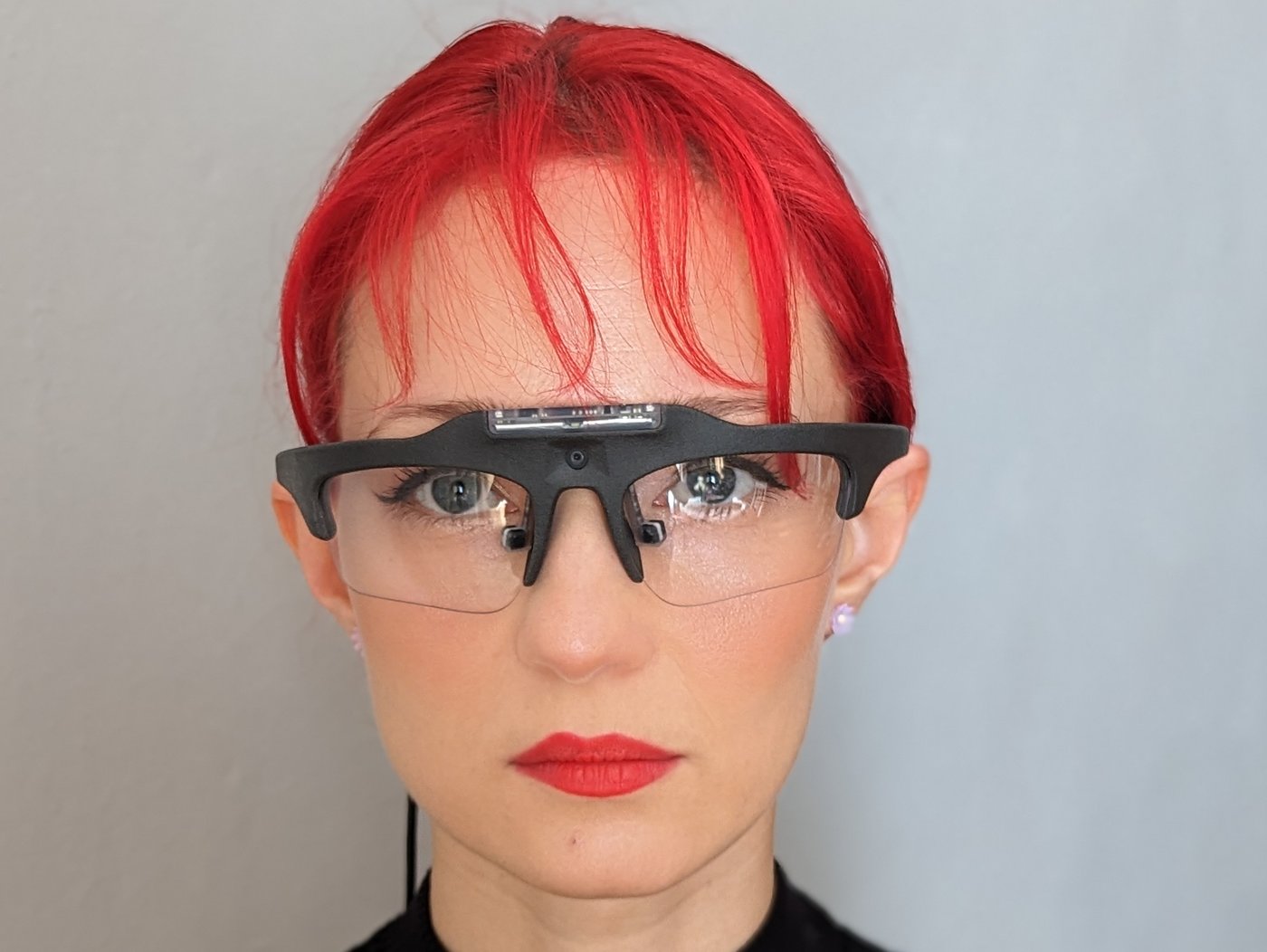
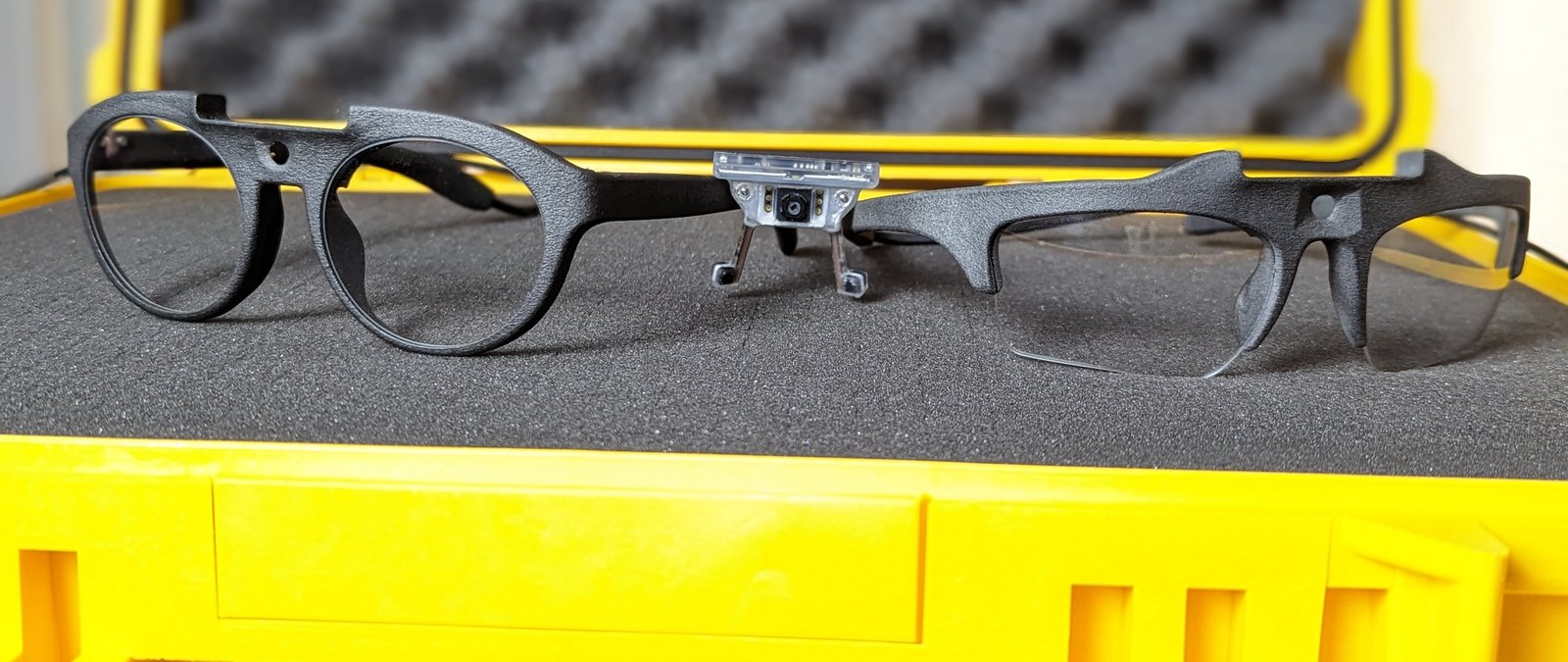
Pupil Labs offers 14 frames. The main ones:
| Frame | Use | Weight |
|---|---|---|
| Just act natural | The look of ordinary glasses, with lenses | 50 g with the module |
| Is this thing on? | Minimal frame, no lenses | 35 g |
| I can see clearly now | Interchangeable corrective lenses, from −3 to +3 dioptres | 48 g |
| Ready set go! | Sport, worn under a helmet | 30 g |
| Better safe than sorry | Professional use | 45 g |
| All fun and games | Children aged 2 to 8 | 39 g |
| Crawl walk run | Children aged 2 to 8, with built-in head strap | 33 g |
| Every move you make | With markers for motion capture | 40 g |
| Bare metal | Module only, to integrate into your own mount | 8 g with the module |
Other frames exist for eye protection and masks. We help you choose.
No calibration, in any environment
Gaze is estimated by a neural network, NeonNet, not by a geometric model that has to be calibrated. According to Pupil Labs:
- no calibration is needed, and the measurement does not depend on the glasses slipping on the nose;
- Neon works from full sunlight to darkness, and during any activity;
- it works regardless of the participant's age, sex or origin, with make-up or contact lenses.
The price of this simplicity is accuracy: 1.8° uncalibrated, 1.3° after an offset correction. That is coarser than a screen-based eye tracker. To tell apart small targets that are close together, check that it is enough for your protocol.
Specifications
| Value | |
|---|---|
| Technique | NeonNet neural network; binocular, left-eye or right-eye modes |
| Calibration | None |
| Accuracy | 1.8° uncalibrated; 1.3° with offset correction |
| Gaze measurement range | 100° by 80° |
| Latency | Under 10 ms |
| Real-time gaze | 200 Hz |
| Pupillometry and eye state | 200 Hz |
| Head movements | Accelerometer, gyroscope, magnetometer; 110 Hz |
| Eye cameras | 2 infrared cameras, 192 × 192 pixels at 200 Hz |
| Scene camera | 1,600 × 1,200 pixels at 30 Hz; field of view 103° (horizontal), 77° (vertical) |
| Audio | 2 microphones |
| Module | 35 × 40 × 10 mm, 7 g |
| Recorder | Samsung S25 phone, connected by USB-C |
| Battery life | 4 hours at 200 Hz; 8 hours at 30 Hz |
| Storage | More than 25 hours of recording |
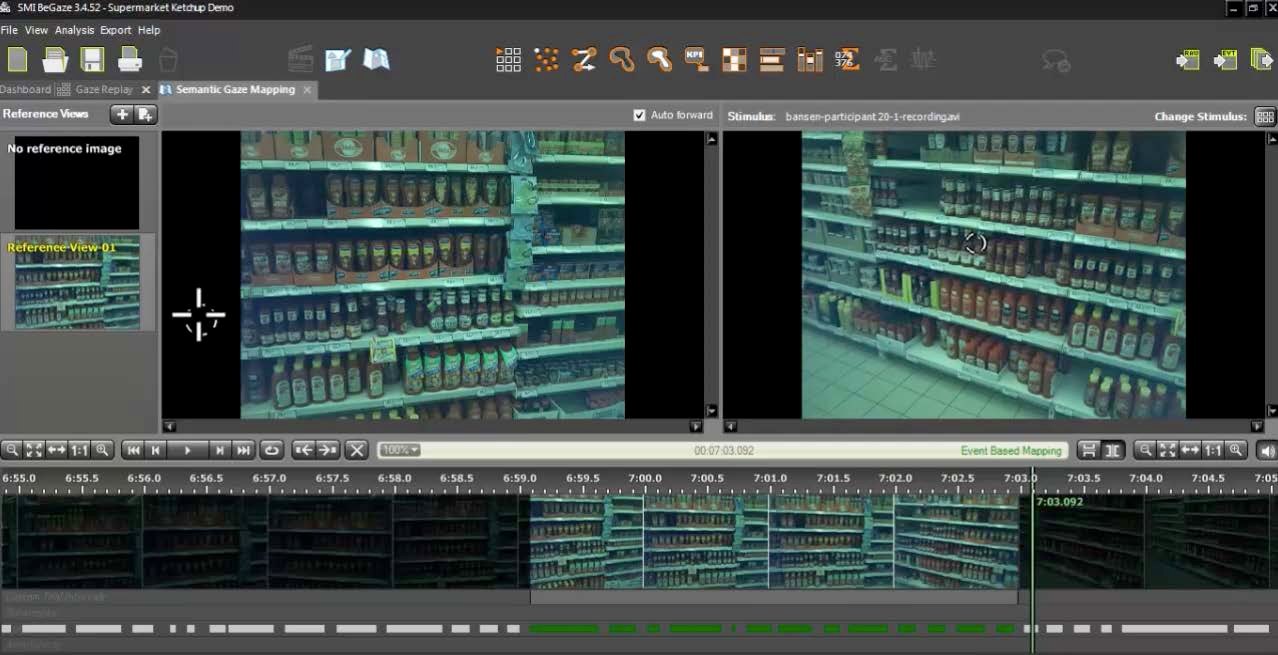
SMI BeGaze: an integration built by Gaze Intelligence
BeGaze, SMI's analysis software, remains a reference for many teams. Gaze Intelligence has developed GazeConverter, a tool that converts Neon recordings and imports them into BeGaze.
- You analyse Neon data with the tools you already know.
- BeGaze's Semantic Gaze Mapping maps gaze recorded in the real world onto a reference image and its areas of interest.
- Your earlier SMI projects and your new Neon recordings stay in the same software.
This integration requires a BeGaze licence. Tell us your version: we check compatibility before any order.
GoLive: gaze and ECG live on a tablet
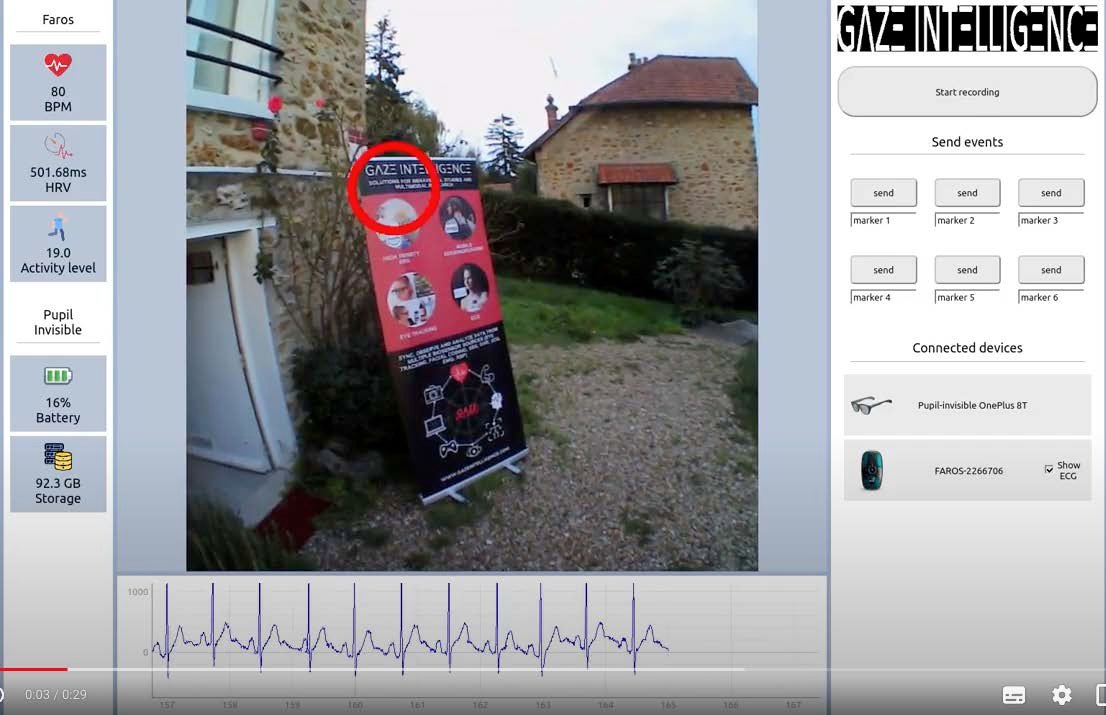
With GoLive, the experimenter follows the session remotely, over Wi-Fi, on a tablet: the scene video with the participant's gaze, plus other measurements such as ECG and heart rate variability.
- Live annotations: mark events during the session.
- Surface tracking: locate a surface of interest in the scene.
- Annotation review after the recording.
The other analysis tools
- Neon Companion: the phone app. It records and lets you replay the video with gaze straight away, without a computer.
- Pupil Cloud: automatic upload of recordings, storage, team access, gaze mapping and online analysis.
- Neon Player: offline analysis on your computer.
- Programming interface to access the data in real time.
- Blickshift Analytics: advanced visualisation and pattern search in scan paths.
For which studies?
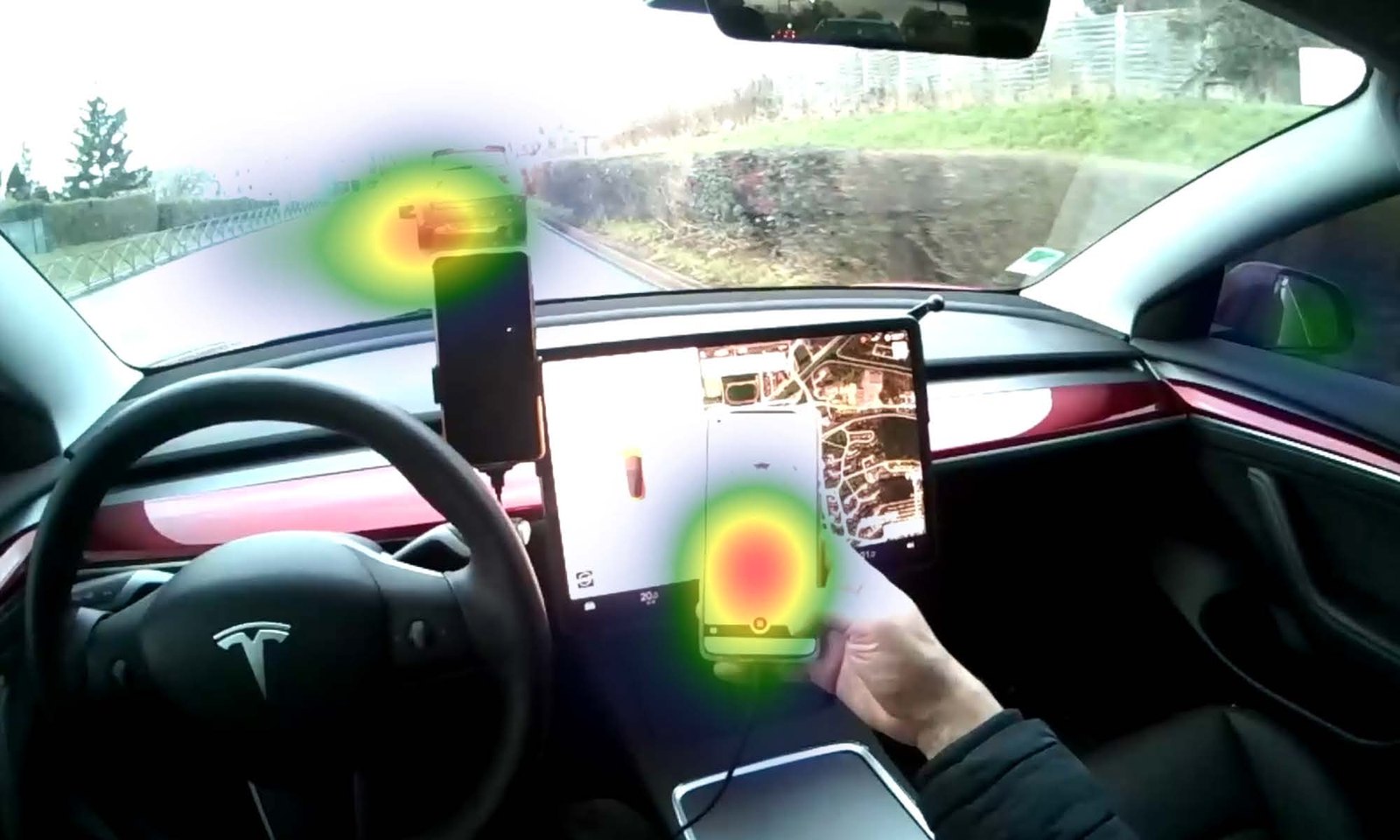
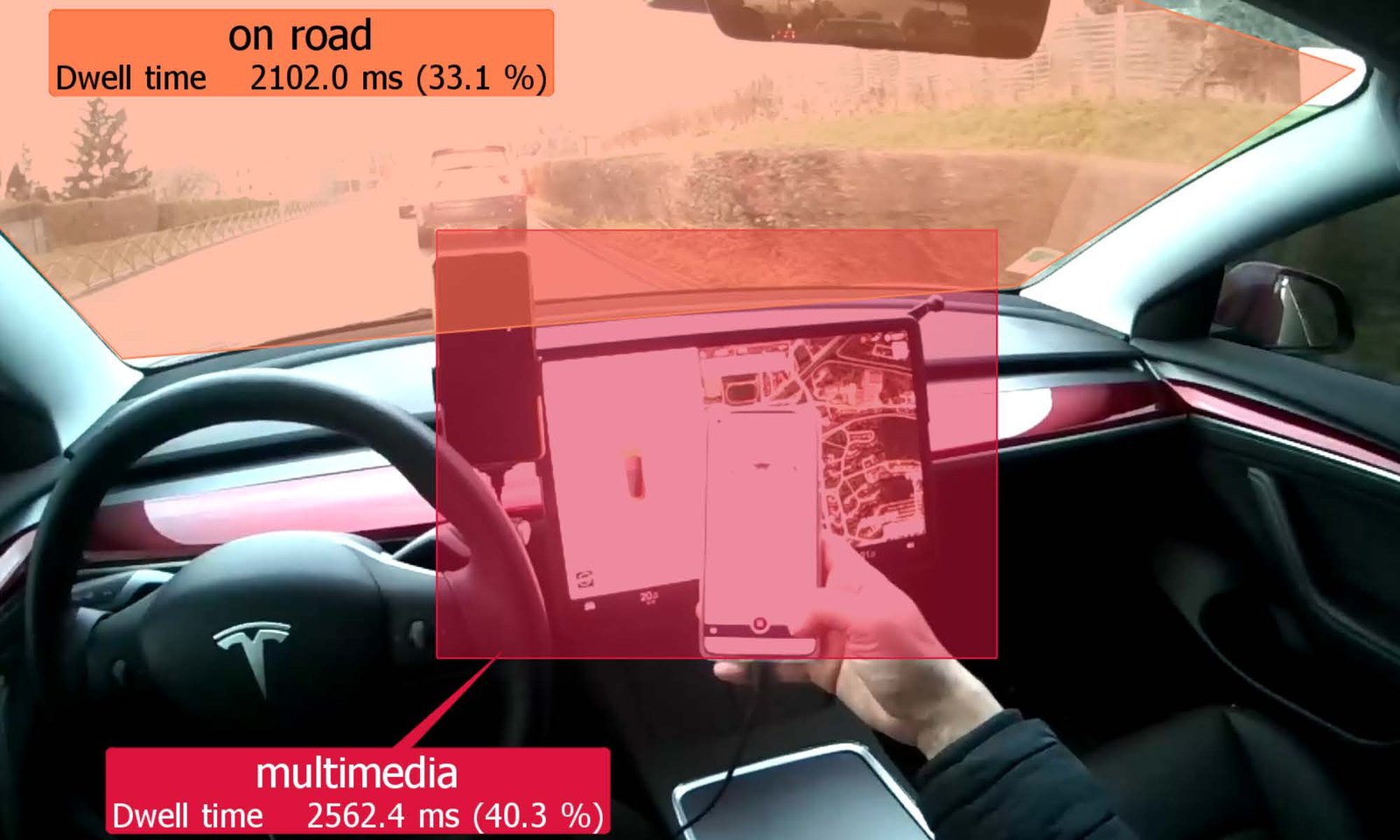
- Ergonomics and human factors: driving, workstations, piloting.
- Sport: one frame is worn under a helmet.
- Child development: two frames for children aged 2 to 8.
- Consumer research and marketing: shops, shelves, customer journeys.
- Psychology and neuroscience in real-world settings, with live ECG.
Publications by French teams using Neon glasses
Four works published between 2025 and 2026, each with at least one author affiliated with a French laboratory, use Neon as a measuring instrument. We checked that use in each text or in the presentation given by Pupil Labs.
Infants aged 3 to 24 months · Grenoble
A custom mount fixes the Neon module to an elastic headband, to record the gaze of babies sitting on a parent's lap.
Jérémie Josse, BabyLab of the Laboratoire de Psychologie et NeuroCognition, Université Grenoble Alpes. “Using Pupil Labs’ Neon eye-tracking module for infants aged 3 to 24 months”, technical report, 2025. hal-05007603
Medical procedure on a simulator · Rennes
The gaze of practitioners is recorded during an ultrasound-guided embryo transfer. Experts and novices do not use the same visual strategies: experts look more at the ultrasound image, with longer fixations.
Josselin Gautier and colleagues, Laboratoire Traitement du Signal et de l’Image, Université de Rennes. “Capturing eye movements during ultrasound-guided embryo transfer: first insights”, SPIE Medical Imaging, 2025. doi:10.1117/12.3046367
Older adults walking in the city · Palaiseau and Singapore
Participants wear Neon while walking through a residential neighbourhood; gaze is fused with movement, physiology and position. The data were collected in Singapore.
Houhao Liang and colleagues, with Panos Mavros, Institut Interdisciplinaire de l’Innovation, Télécom Paris. “Multimodal Data Fusion to Capture Dynamic Interactions between Built Environment and Vulnerable Older Adults”, preprint, 2026. arXiv:2601.11545
Child–parent interactions · Paris, Miami and Tokyo
Children wear Neon in the “All fun and games” frame, designed for young children; parents wear other glasses. A toolkit annotates the recordings automatically.
Iba Baig and colleagues, with Seiji Cattelain, Marie Hallo and Sho Tsuji, École normale supérieure – PSL. “GazeBehavior Annotation Toolkit (GBAT)”, preprint, 2026. arXiv:2605.22962
These works are cited as public references. Their authors are not presented as Gaze Intelligence customers and took no part in writing this page. The list is not exhaustive, and a preprint has not yet been peer reviewed. Pupil Labs also reports more than 1,100 publications produced with its eye trackers, all models combined.
A team that comes from SMI, more than 15 years of eye tracking
Our team worked at SMI (SensoMotoric Instruments), the research eye tracker manufacturer acquired by Apple in 2017. We have been practising eye tracking for more than 15 years: choice of equipment, set-up, calibration, protocol, analysis.
- Advice before you buy: we start from your protocol, your population and your stimuli, not from the data sheet.
- Continuity for SMI teams: we support existing SMI systems (BeGaze, Experiment Center, iView X, RED, ETG) and help renew a fleet without losing working habits.
- A supported start: installation, initial training and first recordings with your team.
Frequently asked questions
Do Pupil Labs Neon glasses need calibration?
No. Gaze is estimated by a neural network, without calibration. An optional offset correction improves accuracy from 1.8° to 1.3°, according to Pupil Labs.
What is Neon's sampling rate?
200 Hz for gaze, pupillometry and eye state. The scene camera records 30 frames per second at 1,600 × 1,200 pixels.
Can Neon data be analysed in SMI BeGaze?
Yes, with GazeConverter, a tool developed by Gaze Intelligence that converts Neon recordings and imports them into BeGaze, including for Semantic Gaze Mapping. A BeGaze licence is required.
Can gaze be followed live during recording?
Yes. With GoLive, the experimenter follows the scene video with gaze on a tablet, over Wi-Fi, along with other measurements such as ECG, and annotates the session live.
Is Neon suitable for children and for people who wear glasses?
Pupil Labs offers two frames for children aged 2 to 8 and one frame with interchangeable corrective lenses from −3 to +3 dioptres. Contact lenses are compatible.
How long can you record?
4 hours at 200 Hz and 8 hours at 30 Hz on battery, according to Pupil Labs. The phone stores more than 25 hours of recording.
How much do Neon glasses weigh?
The module weighs 7 g. With the frame, weight ranges from 30 g to 52 g for the classic glasses, depending on the model.
Sources
- Pupil Labs, Neon specifications, page consulted on 19 November 2026: pupil-labs.com/products/neon/specs
- Pupil Labs, Neon overview, page consulted on 19 November 2026: pupil-labs.com/products/neon
- Gaze Intelligence, “Neon Eye Tracking Glasses” brochure, October 2023 (BeGaze, GoLive and Blickshift Analytics integrations).
Gaze Intelligence distributes the products presented on this page: it is written by a distributor. Specifications are those published by the manufacturer on the date shown; the manufacturer may change them without notice. The trademarks mentioned belong to their owners.