Key points
- The 5 kΩ rule comes from amplifiers with low input impedance. With a modern amplifier, a contact impedance of 40 kΩ does not change the amplitude of the EEG signal (Ferree et al., 2001).
- High impedance does have a real cost, however: it increases low-frequency noise, especially in a warm, humid room (Kappenman and Luck, 2010).
- This slow noise comes from the skin, not from the amplifier. It was measured on an active electrode system: active electrodes do not remove it.
- The right choice depends on what you measure: slow or fast components, session length, number of channels, participants.
Two impedances not to confuse
Contact impedance is that of the junction between the electrode and the skin. It depends on the outer layer of the skin, the electrolyte and the preparation. It varies from person to person, from site to site and during the session.
Input impedance is that of the amplifier. It is a fixed value, determined by its electronics.
What matters for signal amplitude is the ratio between the two. The signal is shared between the contact and the amplifier as in a voltage divider: the larger the input impedance relative to the contact impedance, the less the signal is attenuated.
| Amplifier input impedance | Contact at 5 kΩ | Contact at 50 kΩ |
|---|---|---|
| 10 MΩ (example) | 0.05% loss | 0.5% loss |
| 1 GΩ | 0.0005% loss | 0.005% loss |
Voltage divider calculation: loss = contact impedance ÷ (contact impedance + input impedance). The manual for EGI's Net Amps 400 gives an input impedance of 1 GΩ.
The 5 kΩ rule answered the needs of amplifiers whose input impedance was much lower. It required abrading the skin under each electrode. Attenuation is not the only effect of impedance, however: noise is another, covered below.
What three studies show
| Study | What was compared | Result |
|---|---|---|
| Ferree et al., 2001 | Under 10 kΩ (abraded skin) versus 40 kΩ (intact skin), high-input-impedance amplifier | No significant amplitude change in the EEG frequency bands. Mains noise almost independent of impedance imbalance. |
| Kappenman and Luck, 2010 | One hemisphere below 5 kΩ, the other left at its natural level (10 to 190 kΩ), in a cool, dry room and then a warm, humid one | More low-frequency noise at high-impedance sites, especially in the warm, humid room. More trials needed for the P3. |
| Laszlo et al., 2014 | Active and passive electrodes on the same amplifier, at different impedances | Passive electrodes give the cleanest data at very low impedance, but not above 2 kΩ. Active electrodes do better at the other impedances, but follow rapid voltage changes less faithfully. |
Two reading notes. The study by Ferree and colleagues was carried out by authors from Electrical Geodesics, the manufacturer of Geodesic nets; it did not cover frequencies below 1 Hz, as Kappenman and Luck point out. Their own study was run on an active electrode system.
The authors of the 2014 comparison conclude that the “best” electrode type depends, in a non-trivial way, on the recording circumstances.
What high impedance really costs
Kappenman and Luck distinguish two problems.
The first is ambient noise: as impedances rise, their differences from site to site rise too, and common-mode rejection falls. This problem is handled by the amplifier, with a higher input impedance.
The second cannot be solved by the amplifier: skin potentials. The skin carries a standing potential that varies slowly with sweat gland activity. These variations are larger when it is warm and humid. They produce slow drifts that add to the signal.
The consequences measured in their study:
- the additional noise lies in the low frequencies;
- more trials are needed to obtain a significant effect on the amplitude of the P3, a slow component;
- for the faster N1 wave, statistical power is reduced only in the warm, humid room;
- a high-pass filter and artefact rejection reduce the problem without removing it.
Their conclusion is measured: high impedance can increase noise and reduce statistical power under some conditions, and these effects are reduced by a cool, dry room and appropriate signal processing.
Gel, saline, active electrodes: which to choose?
Sponges soaked in saline solution are not a recent invention. The Geodesic net, described in 1993, houses each sensor in a saline sponge, within an elastic structure that distributes 64, 128 or 256 sensors over the head.
| Gel with skin preparation | Saline (net) | Active electrodes | |
|---|---|---|---|
| Contact impedance | The lowest | Higher, intact skin | Can stay high: the signal is amplified at the electrode |
| Skin abrasion | Yes, to reach the low values | No | No |
| Strength | The most stable slow signals | Fast application of a large number of sensors | Lower sensitivity to ambient noise and cables |
| Limit | Application time that grows with the number of electrodes | Higher slow noise; the solution evaporates over long sessions | Slow skin noise unchanged; rapid changes followed less faithfully (Laszlo et al.) |
Abrasion also has a cost, as these studies point out: preparation time, discomfort, and a risk of infection when the skin is broken. This is a strong constraint with infants and children.
For long recordings, the answer is not to keep adding saline indefinitely. The EGI manual distinguishes two types of net: saline-based for routine short recordings, gel- or paste-based for long recordings.
Seven precautions with a high-impedance system
- Keep the room cool and dry. In the 2010 study, the cool condition was about 21 °C and the warm condition close to 28 °C.
- Plan more trials for slow components (P3, contingent negative variation).
- Choose the high-pass filter with care. The authors point out that a cut-off above 0.1 Hz can clearly distort evoked potentials.
- Apply artefact rejection to large voltage drifts.
- Check impedances before the recording and during breaks.
- Switch to a gel net for long recordings, such as sleep.
- Report your impedances and the room conditions in the methods section.
With an EGI system
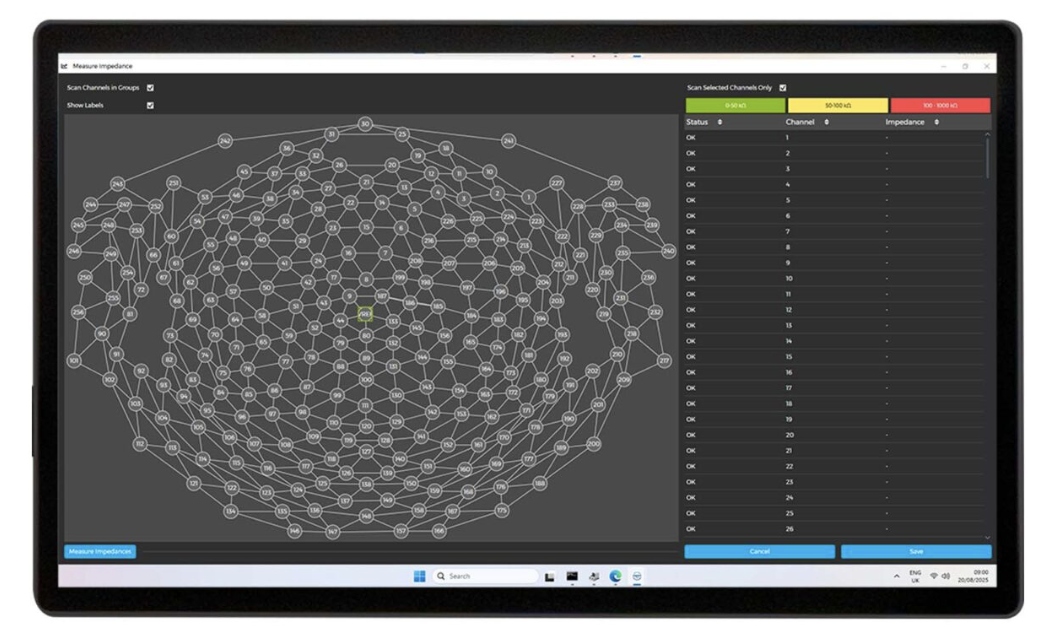
- 1 GΩ input impedance for the Net Amps 400 amplifier, according to its manual.
- Saline-based nets for routine recordings: application without abrasion or glue, about 15 minutes once trained.
- Gel- or paste-based nets for long recordings.
- Impedance check built into Net Station.
Frequently asked questions
Is an impedance below 5 kΩ needed in EEG?
Not necessarily. With a high-input-impedance amplifier, a 2001 study found no significant amplitude change in the EEG frequency bands between under 10 kΩ (abraded skin) and 40 kΩ (intact skin). However, a 2010 study shows that high impedance increases low-frequency noise, especially in a warm, humid room.
Does high impedance degrade evoked potentials?
It depends on the component and the room. In the Kappenman and Luck (2010) study, more trials were needed to obtain a significant effect on P3 amplitude at high-impedance sites. For the N1 wave, statistical power was reduced only in a warm, humid room.
Do active electrodes remove the impedance problem?
Partly. They reduce sensitivity to ambient noise and cables. But the Kappenman and Luck study was run on an active electrode system, and slow noise due to skin potentials still increased at high-impedance sites. A 2014 comparison concludes that the best electrode type depends on the recording conditions.
Who introduced saline sponge electrodes in high-density EEG?
The Geodesic net, described by Don Tucker in 1993: each sensor is housed in a sponge soaked in saline solution, within an elastic structure that distributes 64, 128 or 256 sensors over the head.
How can noise be limited with a saline-based net?
By keeping the room cool and dry, planning enough trials for slow components, choosing the high-pass filter with care, checking impedances before and during the session, and switching to a gel net for long recordings.
Sources
The scientific publications come from PubMed.
- Ferree TC, Luu P, Russell GS, Tucker DM. Scalp electrode impedance, infection risk, and EEG data quality. Clin Neurophysiol. 2001;112(3):536-44. doi:10.1016/s1388-2457(00)00533-2
- Kappenman ES, Luck SJ. The effects of electrode impedance on data quality and statistical significance in ERP recordings. Psychophysiology. 2010;47(5):888-904. doi:10.1111/j.1469-8986.2010.01009.x
- Laszlo S, Ruiz-Blondet M, Khalifian N, Chu F, Jin Z. A direct comparison of active and passive amplification electrodes in the same amplifier system. J Neurosci Methods. 2014;235:298-307. doi:10.1016/j.jneumeth.2014.05.012
- Tucker DM. Spatial sampling of head electrical fields: the geodesic sensor net. Electroencephalogr Clin Neurophysiol. 1993;87(3):154-63. doi:10.1016/0013-4694(93)90121-b
- Magstim EGI. GES 400 Research System Hardware Manual: Net Amps 400 specifications (input impedance) and section “GSNs — HydroCel and MicroCel”.
This article is general information for research teams. It is based on the full text or abstract of the publications cited and on the manufacturer's manual. Gaze Intelligence distributes Magstim EGI systems, which use saline-based nets: this article is written by a distributor. The study by Ferree et al. was carried out by authors from Electrical Geodesics, the manufacturer.