Key points
- The first question is not technical: what is the participant looking at, and can they move?
- Screen-based: the best accuracy and the simplest analysis, for on-screen stimuli and a seated participant.
- Glasses: freedom of movement, at the cost of lower accuracy and longer analysis.
- Virtual reality: a controlled, reproducible environment, with an eye tracker built into the headset.
- Analysis time often weighs more than hardware in the real duration of a study.
The first question: what is the participant looking at?
| The participant looks at… | They are… | Family of devices |
|---|---|---|
| A screen | Seated, head more or less still | Screen-based eye tracker |
| The real world | Free: walking, driving, handling objects | Glasses |
| A virtual environment | Free, inside a headset | Eye tracker built into the headset |
This question settles most cases. Technical specifications only come afterwards, to choose a model within the right family.
Screen-based eye trackers
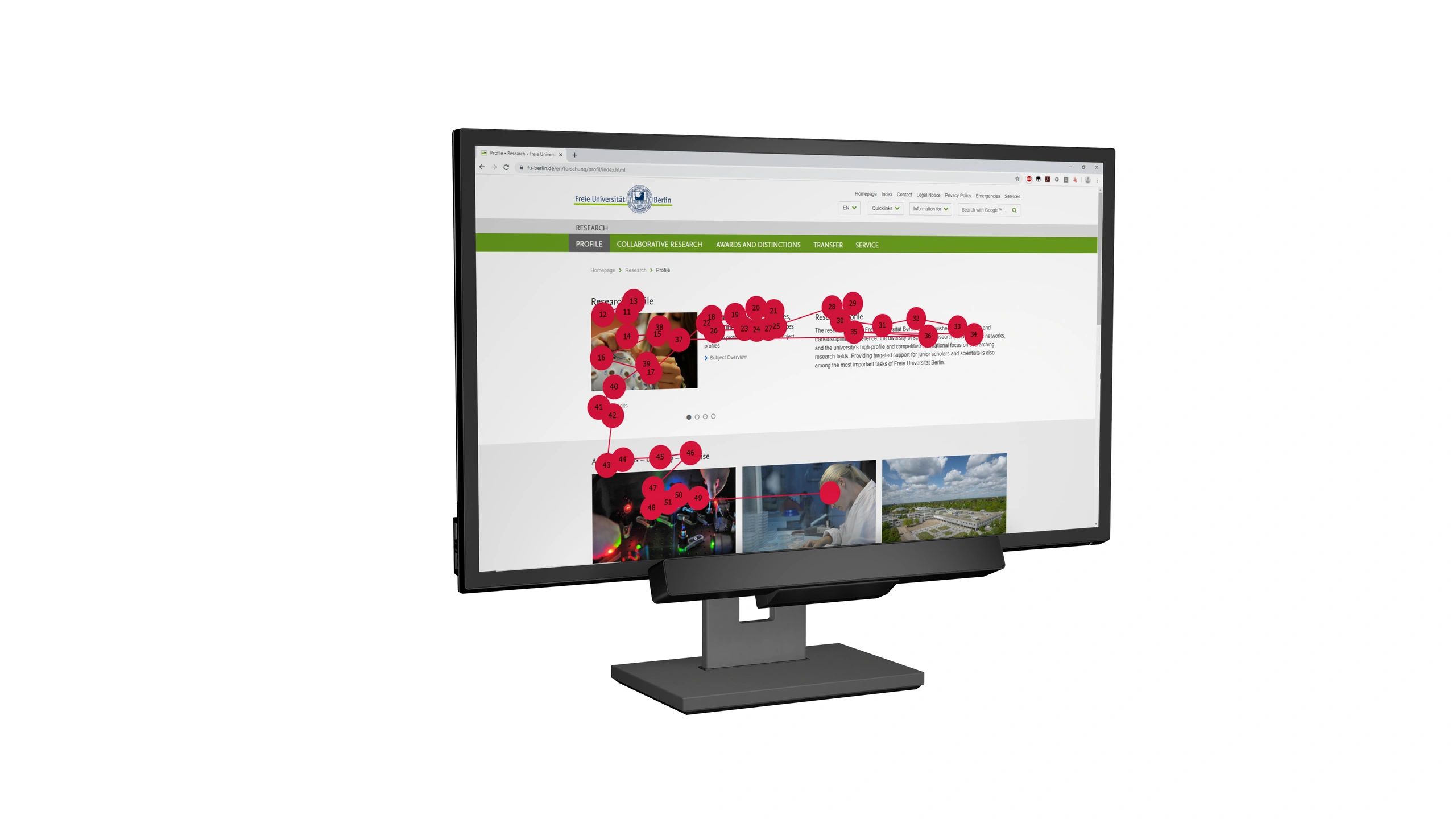
A bar placed under the screen films the eyes and computes where gaze lands on the image.
- For which studies: reading, visual attention, experimental psychology, usability of websites and interfaces.
- Strengths: the best accuracy, high sampling rates, and areas of interest that are identical for every participant.
- Limits: the head must stay within an area of a few tens of centimetres, and everything happens on a screen.
As an example, the EyeLogic LogicOne samples at 250 Hz with a stated accuracy under 0.5°, for a tracking area of 30 cm by 20 cm at 60 cm from the screen.
Glasses
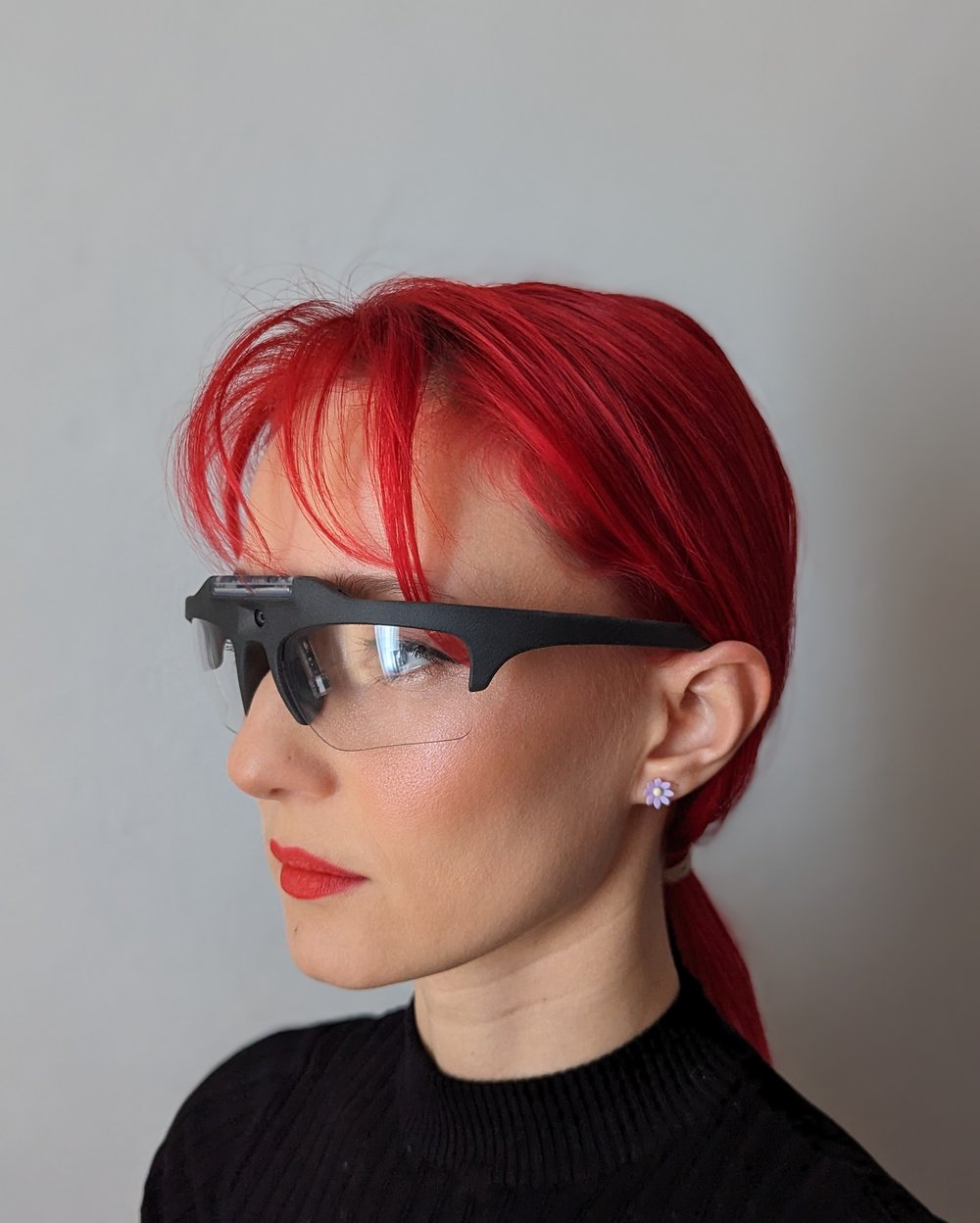
The glasses carry cameras that film the eyes and one camera that films the scene. Gaze is mapped onto that video.
- For which studies: driving, sport, shops, workstations, interactions, child development.
- Strength: the participant does what they would do without the device.
- Limits: lower accuracy and longer analysis.
Two schools coexist. Some glasses require calibration and are more accurate: Tobii Pro Glasses 3 state 0.6°. Others do without it: Neon by Pupil Labs states 1.8° uncalibrated and 1.3° after correction, at 200 Hz.
One point worth knowing: glasses can slip on the nose when the participant talks or moves. A 2020 study of four systems measured, for some of them, additional errors of 0.8° to 3.1° after small displacements. The authors recommend testing your own equipment.
Virtual reality
Virtual reality headsets with a built-in eye tracker are now commercially available, and their uses in research have multiplied.
- What it brings: a scene that is identical for every participant, impossible or dangerous to reproduce in real life, in which the software knows every object.
- Its constraints: the scene has to be developed, the headset weighs on the head, and the eye tracker is the one in the headset.
- Remember: a screen-based eye tracker cannot be fitted to a headset. The hardware is specific.
We study these set-ups case by case, depending on your laboratory's headset and software.
Comparison table
| Screen-based | Glasses | Virtual reality | |
|---|---|---|---|
| Freedom of movement | Low: head within a restricted area | Total | Large, within the play area |
| Stated accuracy | The best: under 0.5° for the models cited | 0.6° to 2.5° depending on the model | Depends on the headset |
| Sampling rate | 60 to 250 Hz for the models cited | 50 to 200 Hz | Depends on the headset |
| Calibration | Yes | Yes or no, depending on the model | Yes, in most cases |
| Stimuli | Images, text, videos, websites | The real world | 3D scene to be developed |
| Areas of interest | Fixed, identical for everyone | To be mapped onto a reference image | Known to the software |
| Analysis time | Short | The longest | Short, once development is done |
Five criteria for choosing a model
- Sampling rate. It describes the time step. The peak velocity of a saccade is far more sensitive to it than the duration of a fixation.
- Accuracy. It sets the size of the targets you will be able to tell apart. At 60 cm, 0.5° is about 0.5 cm on the screen.
- Population. Children, people who wear glasses, patients: check that tracking holds on your participants, not on those in the brochure.
- Synchronisation. If you add EEG, ECG or stimulation software, latency and the synchronisation method matter.
- Software. Presenting stimuli, checking calibration, exporting raw data: the software is part of the choice.
Analysis, the hidden cost
On a screen, every participant sees the same image. An area of interest is drawn once and applies to everyone.
With glasses, each participant films their own scene. To compare, gaze from each video has to be mapped onto a common reference image, or surfaces have to be tracked automatically in the scene. That work is what lengthens a mobile study.
Before you buy, ask to see the whole path: from recording to heat map and table of figures, on an example close to your study.
Three practical cases
A reading study
Sentences on screen, a seated participant. Words have to be told apart, so good accuracy is needed, and saccades described, so a high sampling rate. A 250 Hz screen-based eye tracker is suitable.
A driving study
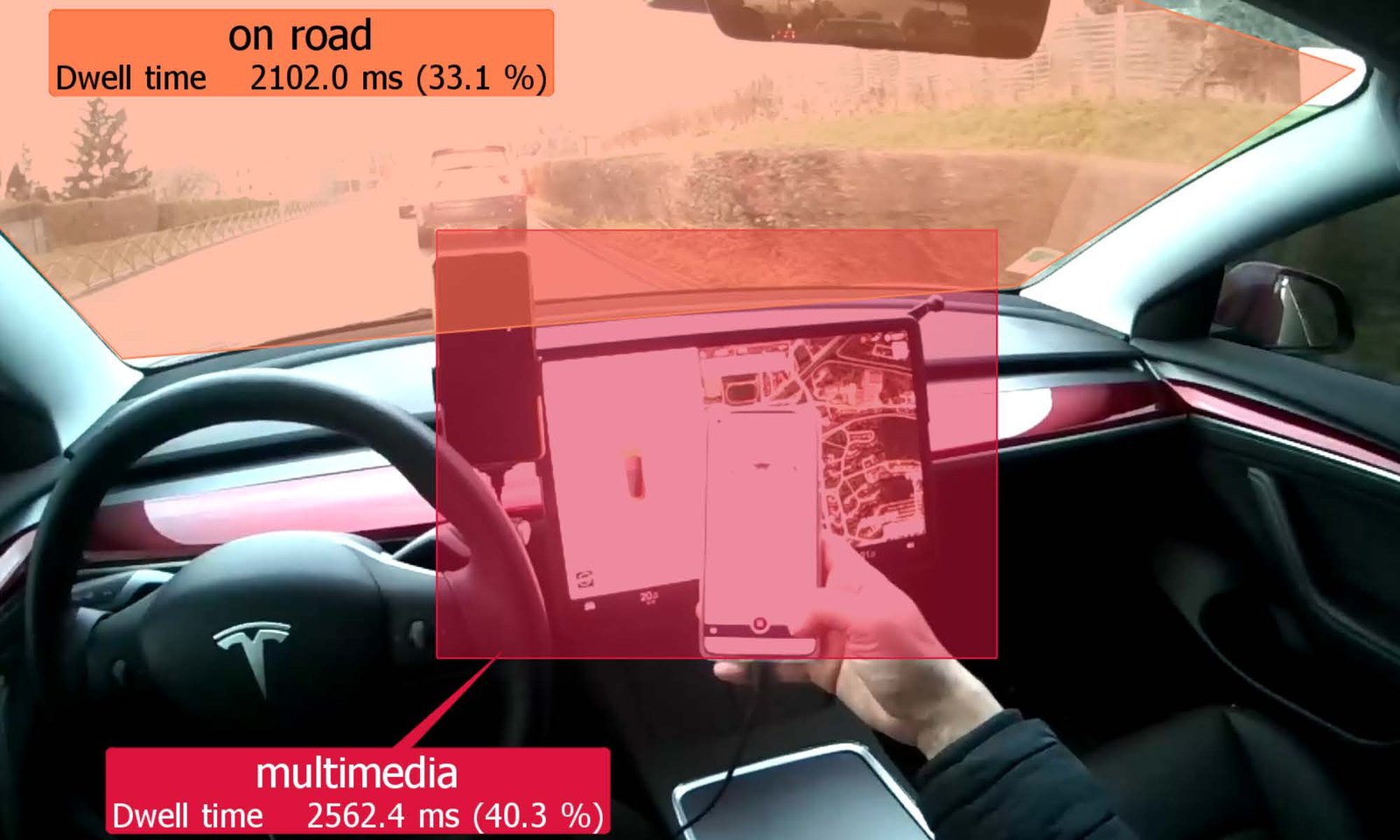
The driver looks at the road, the mirrors, the dashboard. You need glasses, good performance in full sunlight, and a tool to measure time spent on each area.
A study with 4-year-old children
Calibration is hard to obtain and the child moves. Calibration-free glasses, on a frame that fits, avoid the most delicate step. If the stimuli are on screen, a screen-based eye tracker remains possible, with an adapted calibration.
Four common mistakes
- Choosing on sampling rate alone. A fast but inaccurate device will not separate two targets that are close together.
- Forgetting analysis. Time spent after recording often exceeds acquisition time.
- Not testing on your own population. Data-sheet figures are obtained under favourable conditions.
- Underestimating synchronisation. Linking gaze to a stimulus or to EEG requires a known latency.
Frequently asked questions
Screen-based eye tracker or glasses: how to choose?
If your stimuli fit on a screen and the participant stays seated, a screen-based eye tracker gives the best accuracy and the simplest analysis. If the participant moves around or handles real objects, you need glasses.
Are eye tracking glasses less accurate than a screen-based eye tracker?
In general, yes. The screen-based eye trackers we distribute state an accuracy under 0.5°. Glasses state from 0.6° after calibration to 2.5° uncalibrated, depending on the model. In return, they leave the participant free to move.
What sampling rate do I need?
It depends on what you measure. For fixation durations and scan paths, 60 to 120 Hz is usually enough. Saccade peak velocity is far more sensitive to sampling rate: it is underestimated at low rates, especially for small saccades.
Can eye tracking be done in virtual reality?
Yes. Virtual reality headsets with a built-in eye tracker are commercially available. An eye tracker designed for a screen cannot be fitted to a headset: the hardware is specific.
Why is analysis longer with glasses?
Because each participant films a different scene. To compare participants, gaze from each video has to be mapped onto a common reference image, or surfaces have to be tracked in the scene. On a screen, the areas of interest are the same for everyone.
Sources
The scientific publications come from PubMed.
- Dunn MJ, Alexander RG, Amiebenomo OM, et al. Minimal reporting guideline for research involving eye tracking (2023 edition). Behav Res Methods. 2024;56(5):4351-4357. doi:10.3758/s13428-023-02187-1
- Mack DJ, Belfanti S, Schwarz U. The effect of sampling rate and lowpass filters on saccades – A modeling approach. Behav Res Methods. 2017;49(6):2146-2162. doi:10.3758/s13428-016-0848-4
- Niehorster DC, Santini T, Hessels RS, Hooge ITC, Kasneci E, Nyström M. The impact of slippage on the data quality of head-worn eye trackers. Behav Res Methods. 2020;52(3):1140-1160. doi:10.3758/s13428-019-01307-0
- Adhanom IB, MacNeilage P, Folmer E. Eye Tracking in Virtual Reality: a Broad Review of Applications and Challenges. Virtual Real. 2023;27(2):1481-1505. doi:10.1007/s10055-022-00738-z
- EyeLogic, LogicOne and Lite product pages, consulted on 19 November 2026: eyelogicsolutions.com
- Pupil Labs, Neon specifications, page consulted on 19 November 2026: pupil-labs.com
- Tobii, comparisons of screen-based eye trackers and glasses, pages consulted on 19 November 2026: tobii.com
This article is general information for research teams. It is based on the manufacturers' pages and the publications cited. Gaze Intelligence distributes EyeLogic and Pupil Labs eye trackers and supports SMI systems: this article is written by a distributor. The trademarks mentioned belong to their owners.